Pages

Saturday, April 22, 2017

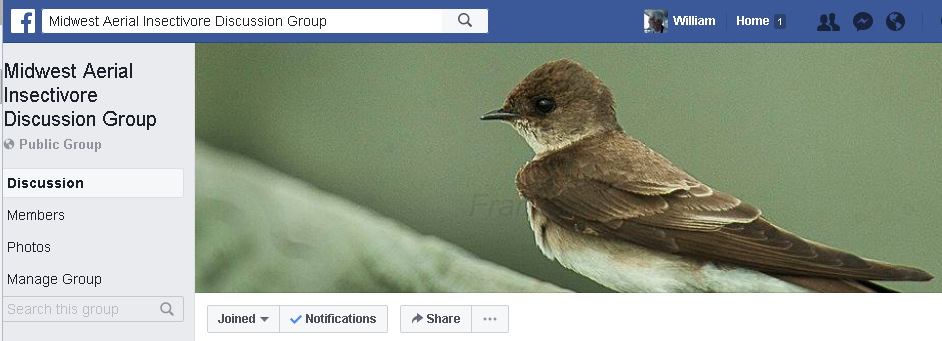
Join the Midwest Aerial Insectivore Discussion Group

This Discussion Group is on Facebook: https://www.facebook.com/groups/1581381955435390/
If you are interested in  swallows, swifts, nightjars, flycatchers and their conservation - take a look!


Tuesday, April 4, 2017

Birds news around the world today

In case you'd like to read about some bird-related work, issues, news from various places around the globe:

BirdLife Cyprus news:

http://us12.campaign-archive1.com/?u=2d1fbb9f4f36d1c44c985f950&id=e42d7db64e&e=43f3c11825

Oriental Bird Club news:

 http://orientalbirdclub.org/

 The Norwegian Ornithological Society 

 http://www.birdlife.no/organisasjonen/english.php

BirdLife South Africa news:

http://www.birdlife.org.za/

How songbirds teach themselves songs:

https://www.sciencedaily.com/releases/2017/04/170404104719.htm

Pink-footed Goose - A bird likely to be increasingly found in eastern North America - Midwestern records coming in the next few years?

 http://www.audubon.org/field-guide/bird/pink-footed-goose

Pink-footed Goose - ph. Wikim. Commons - Dave Dunford


another obit for Chan Robbins

This is from the current (April 2017) Birding Community E-Bulletin, co-authored by Paul Baicich and Wayne Peterson:


CHANDLER ROBBINS: RIP
 
Sadly, the renowned ornithologist, author, educator, and public servant, Chandler S. Robbins, passed away on 20 March. Chan, as he was known to everyone, was 98 years old.
 
He graduated from Harvard with a degree in physics and began teaching math and science in Vermont. Robbins joined the U.S. Fish and Wildlife Service in 1945 as a junior biologist at Patuxent Research Refuge in Maryland, where he engaged in early research on the effects of DDT and had his papers edited by his USFWS colleague, Rachel Carson. Also, Chan was the bander who first banded the Laysan Albatross named Wisdom in 1956. He re-banded her, the world's oldest known banded bird, in 2002. (See last month's E-bulletin for an update on Wisdom:  http://tinyurl.com/E-bMar17 )
 
For many birders in the 1960s, their introduction to birding and to Robbins was through his role as lead author of A Guide to Field Identification: Birds of North America. (See Book Notes above.) In 1966, this book - simply called "the Golden Guide" by many - was a breakthrough field guide with profound features. It covered all of the continental U.S. and Canada; all illustrations were in color; birds were presented in a variety of postures and often in some habitat; text and images were on facing pages; continental range maps accompanied the text; measurements were of live birds, and those puzzling sonograms were first introduced to an eager popular audience.
 
In the same year that the Golden Guide appeared, Chan launched one of the most important citizen science tools that we have today, the North American Breeding Bird Survey. The creation of the BBS was not universally and instantly appreciated, however. He actually received a disciplinary letter in his work file for its premature launch!
 
In 1981, he co-authored the memorable paper familiar to an entire generation of ecologists: "Effects of forest fragmentation on avifauna of the eastern deciduous forest."  This article led to a national effort to identify and prioritize large, still-unbroken tracts of forest while there was still time. In 2012, Chan declared that this was the work of which he was most proud.
 
After his 60 years of full-time work as an avian biologist at the USGS Patuxent Wildlife Research Center (he didn't retire until 2005), Chan became "Scientist Emeritus" at Patuxent where he actually continued to work. One could often find him at his office at the far end of the library, at the Gabrielson building, working on the next paper, the next study, always keeping connected, and always making a difference. Chan Robbins was at the same time a giant in the field of bird study and also a gracious, quietly creative, and unassuming colleague.  The world has lost another of The Great Ones.
Friday, March 24, 2017

please tell Congress to make bird conservation a priority

Please read this message from the American Bird Conservancy:

 "(The current)  proposed 2018 federal budget would gut major programs and protections for birds and America’s public lands, putting decades of conservation achievements at risk. With so much on the line, it’s imperative that we send Congress a loud, unmistakable message that such extreme cuts will not stand.
Drastic reductions in the proposed federal budget would scale down on-the-ground conservation at a time when one-third of migratory bird species, are already in decline. Birds are sensitive indicators of environmental health as a whole, and the loss of migratory birds signals a potential crisis that Congress must act now to reverse.
But that’s not all: Three federal agencies critical to bird conservation—the Department of Interior, the Department of Agriculture, and the Environmental Protection Agency—are facing drastic budget cuts that will significantly reduce federal bird protections.
If we want migratory birds to bounce back, it’s critical that Congress prioritize and fund the following:
  • The Neotropical Migratory Bird Conservation Act, critical to the restoration of habitat for migratory birds throughout the Western Hemisphere.
  • Migratory Bird Joint Ventures, North American regional partnerships that work across political boundaries and levels of government to achieve conservation success for birds and their habitats.
  • Endangered Species Act, in order to fully recover endangered and threatened bird species.
  • Farm Bill conservation programs, like Conservation Reserve Program, which preserve habitat for birds by providing conservation incentives to private landowners.
  • EPA’s Pesticides Program, critical to protecting birds from deadly pesticides like neonicotinoids used in agriculture.
Please act now! Tell your Senators and Representative: Make protecting migratory birds and the conservation programs they depend on a priority." 

Please take action at:  https://secure2.convio.net/abcb/site/Advocacy?cmd=display&page=UserAction&id=305

Thursday, March 23, 2017

Owl Surveyors needed (in Wisconsin)

The 2017 Western Great Lakes Owl Survey is just around the corner with observers conducting TWO surveys of their pre-determined roadside route, the first between April 1 and 10 and the second survey between April 21 and May 1. Each route takes about 1.5 hours to complete. An awesome group of volunteers has accounted for many routes again this year but I need your help in filling those that remain open. Visit the survey's website below to view route availability and locations and to sign up. And do so quickly to get the route you want!

http://wiatri.net/projects/birdroutes/owls.htm

All new surveyors must pass a brief online certification procedure prior to the actual survey dates. Routes will be assigned first-come, first-serve but keep in mind I need to manually approve your request so it may take a few days before the map symbol changes from green (available) to red (assigned). As such it's possible that a route shows as green even if someone else has already requested it. You will receive an email reply from me one way or another to let you know if the route is yours or you need to select an alternative. You may also list an alternative in your original route request.

Thanks for your interest in this fun survey!


We are committed to service excellence.
Visit our survey at http://dnr.wi.gov/customersurvey to evaluate how I did.

Ryan Brady
Science Coordinator, WI Breeding Bird Atlas II Bird Monitoring Coordinator, WI Bird Conservation Initiative Wisconsin DNR - Wildlife Management
Phone: (715) 685-2933
Cell Phone: (715) 685-8585
Fax: (715) 685-2909
ryan.brady@wisconsin.gov

Int'l. Migratory Bird Day - Forest Beach Migratory Preserve - May 20

Join us for a day of great activities on May 20th - see the list at left.